
A Mural on Buckeye
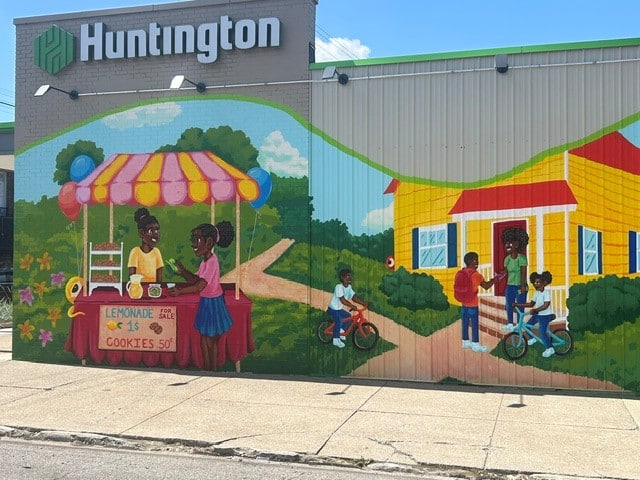
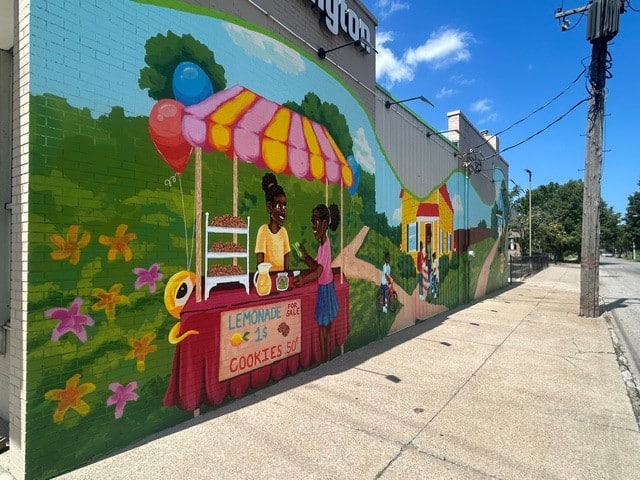
Earlier in August, a new mural was unveiled on the side of the Huntington Bank branch on Buckeye Road. The installation is the work of local artist, Christa Freehands, and depicts the energy and entrepreneurial spirit of the neighborhood. The mural focuses on the efforts and industry of young people: a lemonade stand, kids mowing lawns and riding bicycles. It celebrates the community in bright acrylic colors, bright and hopeful images.
The Saturday morning unveiling was a joyous one for the Buckeye area. A local radio station played music in the bank parking lot. There was an ice cream truck and food vendors. Representatives from the LAND Studio, Collective Express and New Era Cleveland, who sponsored the mural, were joined by representatives from Huntington Bank to introduce the artist and join in a ribbon cutting ceremony. The event coincided with the monthly Bike Your Neighborhood event, which arrived at the site in time for the ribbon cutting. The cyclists headed to Shaker Square next, where a community resource fair was being held by the Morelands Group. It was a busy morning.
Two years earlier, the neighborhood was at risk of losing its bank branch.
Huntington Bank announced the closure of the Buckeye Road location in 2024, as part of a restructuring of its retail bank operations. Residents pushed back. Bank customers worked with local organizations, block clubs and elected officials to appeal the bank’s decision. A petition drive collected thousands of signatures. Individual and business account holders spoke up about the importance of a full-service bank branch in the area. Huntington withdrew its petition to close the branch. The new mural was more than just a piece of public art; it was also a symbol of the coordinated community effort that engaged businesses, civic groups and residents to promote the livability and vitality of their neighborhood and make an investment in its success.
The Buckeye-Shaker area has seen dramatic changes over the past century. In the 1920s, the Van Sweringen brothers established the rapid transit lines that connected the neighborhoods with downtown and Public Square. Shaker Square, one of the oldest planned shopping and commercial districts in the US, was completed in 1929. High-density housing and apartments followed. But economic and demographic changes in the 1970s led to disinvestment in the area, including the business districts along Buckeye Road. Redlining practices lead to a deterioration of housing stock. The percentage of locally owned businesses and owner-occupied housing declined.
But the area and its residents are resilient. The Buckeye-Shaker census track is comprised of multiple neighborhoods, and a number of community development and advocacy initiatives. The mural projects along Buckeye Road are part of the work of the LAND Studio to present public art and accessible public spaces in communities across Cuyahoga County. The Saint Luke’s Foundation, emphasizes community development in Buckeye-Shaker, including residents’ input in place-based investments in the neighborhoods. Community development organizations, including Burton, Bell, Carr Development and Cleveland Neighborhood Progress help spur public and private investment in the area. These organizations are joined by many civic groups, including Neighbor Connections and New Era Cleveland that foster resident-led community projects and community associations, including Larchmere Community Association and the Shake Square Alliance. Many organizations and individual advocates came together to champion the importance of the Buckeye bank branch. Huntington Bank leadership took notice. They met with residents and community officials and committed to maintaining their presence in the area.
It’s more than a bank.
The decision to close a retail bank branch was not unique to Buckeye. According to an article in Retail Banker International, more than twenty percent of US bank branches have closed since 2009. There are a number of factors contributing to this. Automation and technology make it easier to conduct transactions online or at a convenient ATM. Banks can reduce labor and property costs. The reduction in brick-and-mortar retail over the last decade also contributed to reducing the number of bank branches. Banks’ “rationalization” of their branch strategy meant that some large banks closed one-third or more of their retail locations in recent years.
Despite the proliferation of ATMs, banking apps and e-commerce options, most consumers express a preference for having access to a branch bank. A 2022 GlobalData survey of financial services consumers found that 58 percent of Americans would not use a bank that didn’t have a convenient branch near them. Even if they don’t visit it often, they want to have the option. Some banking services, like safety deposit boxes or Certificates of Deposit require a physical location. A few banks have added locations – or limited the reduction in branches – as part of a strategy to grow deposits and market share.
Banks and banking establishments are instrumental to economic benefits in communities. Banks foster development in community and infrastructure with investments in housing, businesses and public spaces. Among the voices advocating for keeping the Buckeye Road branch were the small businesses and churches that held accounts there and relied on the ability to deposit cash from business transactions or Sunday offerings. This was amplified by individual depositors who live in the neighborhood. The businesses relied on the branch as part of their day-to-day operations. Residents had direct deposit of payroll or retirement checks, but they chose a bank because it had a presence in their community.
Beyond their role as a place for business transactions, banks have symbolic value to neighborhoods. They are an indicator of safety, economic vitality, and community stability. An article in the Oxford Journal of Gerontology explores the link between access to a local bank and neighborhood perceptions. Residents’ views of their own environment, and the extent of “social cohesion, trust and a willingness to work on behalf of the common good” are based in part on the presence of a local bank. A retail bank, credit union or savings and loan institution is seen as a community asset. In community meetings, Buckeye-Shaker residents pointed to the presence of a bank, a supermarket or a department store as signs of success and stability.
Residents’ perceptions of their neighborhood can impact health outcomes. Lower perceptions of neighborhood safety or cohesion can contribute to poor mental health, depression, obesity or functional decline. A bank branch can be a component of “third spaces” in communities—places where people interact outside of work or home. A conversation with the teller at the counter, or with other customers in line, contributes to greater awareness and connection with others, in the same way that coffee shops, community centers and branch libraries do. Third spaces contribute to the livability of a community. They help make it possible to age in place. At Benjamin Rose we see the potential and the opportunity in Buckeye-Shaker. It is our neighborhood. And we are proud to partner with the residents and organizations in the community that make it a good place to call home.