
Age Friendly
Grow old along with me!
The best is yet to be….
Ringo Starr recorded Grow Old With Me for his 2019 album, What’s My Name? At the time of its release, the recording was remarkable as a Beatles’ reunion of sorts. Paul McCartney played bass on the track, while John Lennon had written and recorded the song forty years earlier as part of his Double Fantasy sessions. Lennon’s version appeared on Milk and Honey, analbum published after his death. The song borrowed part of its lyrics from Rabbi ben Ezra, a poem written in 1868 by Robert Browning.
Robert Browning’s poem embraces the aging process, rather than fearing it. Browning was inspired by the life and work of Abraham ibn Ezra, a twelfth century poet and scholar, and the idea that adventure and discovery are possible at any age. Age and experience and wisdom should be prized along with youth and vigor. They are part of the whole experience of life.
Our perceptions of aging are comprised of our own personal experience of growing older, and our observations of those close to us on the aging journey. We are also impacted by how communities and society view older adults, and their collective ability and commitment to the well-being and engagement. For more than 35 years, the Age Friendly movement has focused on identifying and addressing barriers facing older adults. Here are some recent examples of age-friendly efforts close to home:
According to the Institute for Healthcare Improvement, there are currently 146 hospitals, nursing homes, clinics, and care facilities in Ohio recognized as Age-Friendly Health Systems.
- In April, Cleveland State University held a forum on its commitment as an Age Friendly University.
- Last Fall, Ohio was designated as an Age-Friendly State, becoming the thirteenth state to earn the designation.
- Last year, the City of Cleveland launched its Age-Friendly Cleveland 2025-2028 Action Plan, a roadmap that was created in collaboration with multiple city departments and community organizations. Cleveland was the first city in Ohio to receive the Age Friendly designation in 2014.
- Cuyahoga County launched its Livable Cuyahoga County initiative in 2022 with a community assessment based on the 8 Domains of Age Friendly Communities.
What does it mean to be “Age Friendly”?
In 1991, members of the United Nations adopted its Principles for Older Persons. The resolution encouraged governments to include human rights of older adults in their national policies and programs. Over the next decade, the World Health Organization developed Active Aging: A Policy Framework to help promote healthy and active aging, and “build a society for all ages.” Local cities and communities across the globe began to share best practices on policy, city planning and other actions to address the growing population of older adults. Among the goals identified for sustainable development across the globe was to “Make cities and human settlements inclusive, safe resilient and sustainable by ensuring universal access to safe, inclusive and accessible green and public spaces, including for older people.”
Age Friendly Communities incorporate 8 Domains of Livability into their built and social environments. In the United States, communities enrolled in the AARP Network of Age-Friendly States and Communities to organize their efforts around one or more of the following:
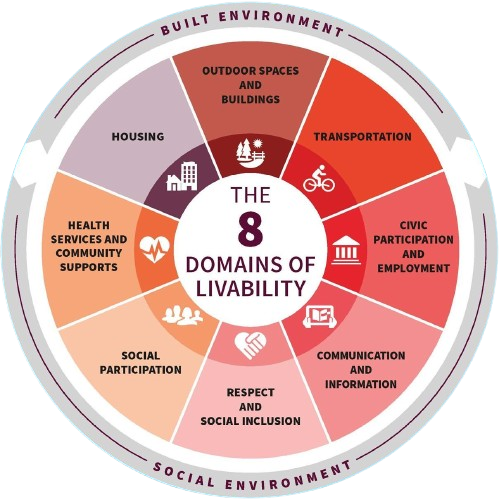
- Housing
- Transportation
- Health Services and Community Supports
- Outdoor Spaces and Buildings
- Social Participation
- Civic Participation and Employment
- Communication and Information
- Respect and Social Inclusion
As part of its commitment to being an Age Friendly Community, Cuyahoga County released a needs assessment report in 2023. The County’s efforts focus on three of the eight domains:
- Transportation: including driving, public transit, and pedestrian and bike-friendly options
- Housing: including housing options suitable for al ages and incomes, as well as home modifications and renovations that help people to “age in place.”
- Social Participation: including strategies to promote inclusion and reduce social isolation.
Age Friendly Universities applythe Age Friendly Principles to higher education. Among these are efforts to promote participation by older adults in the core activities of education and research. AFUs consider the needs of non-traditional students and those pursuing second careers. These institutions seek to promote intergenerational learning, and an appreciation of the longevity dividend—the complexity and richness that aging brings to society and culture. Cleveland State is one of four universities in Ohio that have achieved the Age Friendly designation. (The others are Miami of Ohio, University of Akron and University of Cincinnati.)
Age Friendly Health Systems focus on delivering safe, evidence-based care for older adults. AFHS is an initiative of The John A. Hartford Foundation (JAHF) and the Institute for Healthcare Improvement (IHI). Age Friendly Health Systems focus on the 4Ms Framework:
- What Matters: Know and align care with each older adult’s specific health outcome goals and care preferences across settings of care, including, but not limited to, end-of-life care.
- Medications: If medications are necessary, use age-friendly medications that do not interfere with What Matters, Mentation or Mobility.
- Mentation: Prevent, identify, treat and manage depression, dementia and delirium across settings of care.
- Mobility: Ensure that older adults move safely every day in order to maintain function and do What Matters.
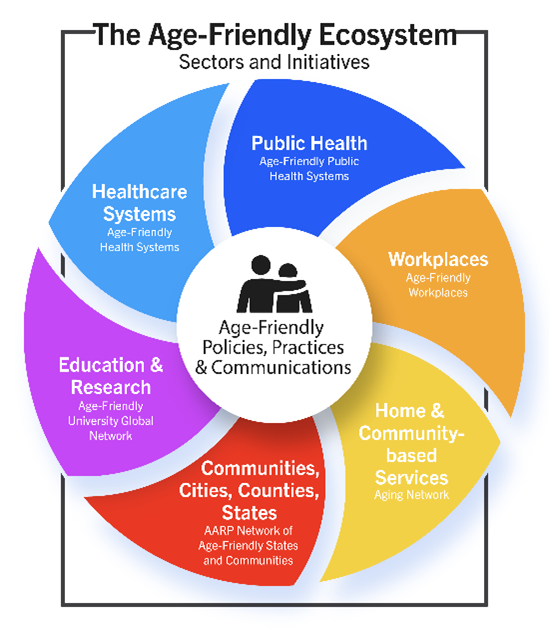
AFHS consider the needs of the whole person. For older adults living with multiple chronic health conditions, this requires seeing the patient as a person first, and not merely as a sum of their diagnoses and treatments. Health systems also may certify their emergency departments and surgical services as Age Friendly. And, because “good health” is more than just medical care and treatment, the conversation and considerations extend beyond the walls of hospitals, nursing homes, and other health providers. Age-Friendly Ecosystems help build connections and collaborations with communities, nonprofit service providers (including Benjamin Rose), universities, public health organizations and healthcare providers.
Age Friendly is for everyone.
Age Friendly efforts are not only for older adults. Instead, they are the recognition of changes in demographics and population, not only in the US, but around the globe. Advances in science and technology, improvements in healthcare and growing wealth in developing nations have led to more people living longer. Increases in life expectancy means a growing percentage of the population is older. And this leads discussions about how society meets the needs of all its residents, and the opportunities we all have to participate and contribute to its success. Age Friendly efforts help build upon the quality of life for all of us, to live in a world where we can age with dignity, independence and respect.