

Yard Shoes
Last weekend I retired an old pair of shoes, a maroon pair of Converse All Stars. After years of faithful service, the soles of both shoes wore through at the heels. When the inside of a shoe is visible from the outside, it’s time to think about getting a different pair. All in all, I got a lot of mileage out of that pair of sneakers. It was a good run.
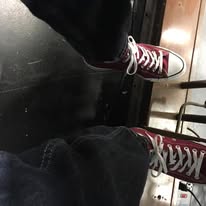
Converse All Stars, or “Chucks” have been around for over a century. The shoe was designed for basketball, with its “non-skid” sole, rubber toe cap, canvas lining and available high top that provided ankle protection (and a place for the ubiquitous star logo). Chuck Taylor, a former player turned sales rep for Converse, helped design the shoe and promoted its use among ball players and coaches. My father attended a basketball clinic put on by Converse and Chuck Taylor in the 1950s.* The shoe dominated the market for decades.
By the time I started high school, Chucks were not the cutting edge of sport shoe technology. Newer shoes hit the market. New materials. Better arch supports, more padding. Converse competed with Adidas (three stripes) Nike (swoosh) and Pony (chevron stripe). Running shoes also cut into the market (Tiger, Nike, Puma and Adidas). Chucks may not have been the go-to athletic shoe anymore, but they were still cool. Offered in a wide variety of colors, and available in all sizes, All Stars were part of every kid’s wardrobe. A middle school insult might include calling out your “buddies” —knock off versions of the coveted Chucks. The white rubber toe caps and the canvas uppers were easy to personalize with Sharpies, stickers, and later, Wite-Out and Liquid Paper. You could sport your favorite team colors or go with basic black or white. Since the eighth grade, I’ve had a pair of Chucks in my closet (not the same pair.) My team basketball days are over, but I still have the shoes.
A new, clean pair of Chucks is a wardrobe staple. Wear them with jeans, or shorts. Socks or no socks. If they get wet or muddy, they go in the washing machine. Playing in cover bands, Chucks were part of the uniform. They were my boat shoes, my beach shoes. I wear them a lot. Eventually they get worn, stained and a little ragged around the edges. And then they become my yard shoes.
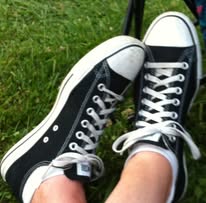
Yard shoes were the ones worn to mow the grass, clean the gutters, or paint the garage. They absorbed paint stains, grass stains and the gunk from the gutter. They were the shoes I wore to hike through a creek, mulch the garden beds or any of the many other dirty jobs around the house. Eventually, the rubber tread of the soles would get slick or wear through completely. I could no longer wear them. Then another pair, not quite as worn, became my yard shoes.
When my wife and I moved to Cleveland as empty nesters, we decided to trade our suburban home for a condominium in the city. We left behind the yard work and house maintenance. We got rid of the riding mower, the rakes and the extension ladder. We have planters on our deck instead of a backyard garden patch. I don’t wear my yard shoes nearly as often. So, it took longer to wear them out.
I did a quick Google search of “Yard Shoes” and discovered that it is possible to buy new yard shoes (Who knew?) with names like Sloggers or Mucksters. I found an online review of how well these purpose-built shoes perform when pulling beets, cleaning a chicken coop, digging out a stump or hand tilling in the garden. I can’t speak personally about their chicken coop capabilities, but I am certain my Chucks performed well in the other tasks. Technology and new materials made All Stars obsolete for basketball. Maybe those people at Muckster are on to something. There are a lot more people mowing grass and pulling weeds than there are playing college hoops.
Household chores, including yard work, home repairs and housekeeping are part of home ownership. Many tasks are part of renting a place of your own as well. Whether inside or outside, these activities consume time and effort. For older adults, the completion of household chores can contribute to a sense of accomplishment. The folded laundry, the sidewalk cleared of snow or the freshly mulched flowerbed add to our self-esteem. They contribute to positive subjective well- being (our sense of balance between positive and negative elements of health) and psychological well-being (how we manage existential challenges in our lives.) If you ever sat down with a cold drink after mowing the lawn, and admired how it looked, you’ve experienced a boost in your sense of well-being.
In Housework, Health and Well-Being in Older Adults, an article published in the Journal of Family Psychology, the authors explore the links between household chores and healthy aging. Housework may contribute to your sense of well-being, but it may also be a source of physical and emotional stress. Household chores have been called the “second shift” — tasks that are completed after a day of work or caring for loved ones. Physical or mental exhaustion may limit recovery from daily activities, which can increase cortisol levels and impact the quality of sleep. Clothes get dirty, and leaves clog up gutters, whether or not you are too tired to fold laundry or climb a ladder. Household division of labor —who mows the yard or prepares the meals —is often a source of marital conflict.
The perception of fairness** in the responsibilities for these tasks affects how we feel about the work to be done. One partner in a relationship may feel overwhelmed by the responsibilities. Individuals experiencing the loss of a loved one may worry over tasks their partners used to do. How you feel the tasks matters as much, or more, than your ability to do them.
I don’t have as many outdoor chores these days, but I see them happening all around me. Lawn mowers will be put away. The community gardeners have picked their last tomatoes. Rakes and leaf bags are out. Eventually, the snow shovels will be out, too. It will be time to cover up the patio furniture in anticipation of winter. And I will think about picking up a new pair of Chucks, my future yard shoes.
If you are exploring options about aging in place, including performing those household chores, there are resources at Benjamin Rose to help guide that conversation, for yourself, or with a loved one you care about. Visit our website to learn more about housing options, exploring services, or assisting older adults in the neighborhood as a Village volunteer.
Notes
*My dad learned about eye-hand coordination and the fundamentals of shooting a basketball at a Chuck Taylor clinic. He also perfected taking a hook shot with either hand. In his 60s he could still beat most of the neighborhood kids at H-O-R-S-E or a game of one-on-one.
**I got a view of the fairness principle as a kid when my cousins came for a visit to my grandparents. Living nearby, I would do yard work for them, and my Granddad paid me to help. One summer while they were visiting, my cousin Wayne joined us in mowing, raking and trimming the lawn. Granddad divided the payment between Wayne and me. His sister, helping Grandma in the kitchen, was not compensated for her effort (at least not at first!) It was an early lesson in division of labor and pay equity.
My yard shoes were sneakers. I don’t recall Granddad ever having a pair. His yard work attire was an old pair of dress shoes. Usually black ones. This along with a white dress shirt that was too worn out for the office, and a pair of dress pants (they were usually gray) that were no longer suitable for work. I never saw him in a pair of jeans, or cargo shorts.