Balancing Your Caregiving: Prioritizing Self-Care While Supporting Your Loved One Caregiving is an inherently demanding role because it involves caring for two individuals: not only the person you provide care for, but also yourself. This dual responsibility makes the role uniquely challenging, requiring you to balance the needs of your loved one with your own well-being. When you introduce family dynamics into this equation, the... Read more
A new GUIDE for Caregivers The Centers for Medicare & Medicaid Services (CMS) estimates that dementia affects more than 6.7 million Americans. Many of those people have multiple chronic conditions, such as diabetes, heart disease or Parkinson’s. This may mean increased rates of hospitalization and fragmented care. Caring for a loved one can become complex and exhausting for the caregiver.... Read more
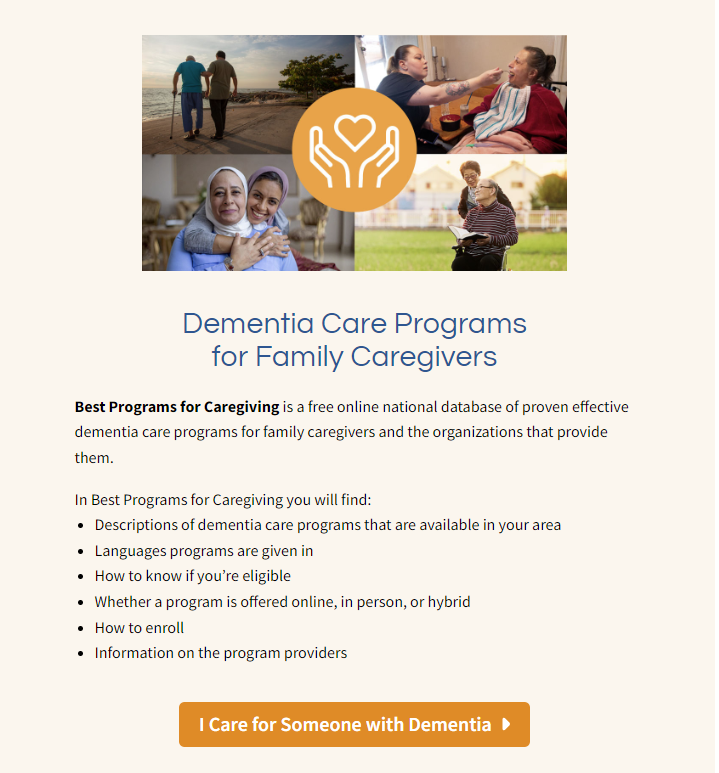
Best Programs for Caregiving Best Programs for Caregiving is a first-of-its kind, free online database that offers family and friend caregivers detailed information about proven dementia care programs that are available in your own community. Read more
Supporting LGBTQ+ Older Adults: Tips for Caregivers As our population ages and society continually evolves, awareness of the diverse needs of different communities of older adults has increased. LGBTQ+ rights have undergone some major changes over the past few decades, and while there have been great triumphs, there have been many challenges as well, including some that are particular to older individuals. Caregivers must be aware of these specific challenges and provide holistic, inclusive support to ensure the well-being of their LGBTQ+ older loved ones. Here are key considerations and strategies for caregivers dedicated to supporting LGBTQ+ older adults. Read more
Navigating the Path: A Guide for New Dementia Caregivers Becoming a caregiver for a loved one with dementia is a profound and, at times, overwhelming journey. It's a role that comes with many responsibilities and challenges, and requires careful planning. If you've recently become a dementia caregiver, here's what you can expect and some recommendations to help you along the way. Read more
Understanding Glaucoma: A Guide for Caregivers of Older Adults Ensuring the well-being of older adults involves comprehensive care, and one aspect often overlooked is eye health. Glaucoma, a progressive eye disorder leading to optic nerve damage and potential blindness, is a significant concern, especially among older adults. As a caregiver, it's crucial to integrate glaucoma testing into the care plan, given its prevalence and potential severity. Read more
Decoding Dementia’s Genetic Connections Dementia affects millions of individuals globally. While age, not genetics, is the primary risk factor, there's growing evidence that genetics can indeed play a role in determining an individual's susceptibility to certain types of dementia. Read more
WeCare…Because You Do℠ WeCare is a telephone- and email-based care coaching program designed to assist and support older adults living with chronic conditions and their caregivers. Read more
Senior Companion Our Senior Companion Program connects older adults with a trained peer volunteer who can offer companionship and minimize isolation. Read more
The Power of Memory Cafés for Dementia Care Most communities have plenty of gathering spaces available for people to meet up, chat, share a meal and take a break in a relaxing, supportive environment. But for people with dementia and their caregivers, finding a truly safe space out in the community can be a lot more challenging. Due to stigma and lack of knowledge, many people in the general public aren’t sure how to interact with someone with dementia, and even business owners may be at a loss to handle a situation where someone with dementia is distressed, or struggles to make a purchase. Aware of these challenges, caregivers may hesitate to bring a loved one into the community, unintentionally putting them at risk of social isolation. Read more