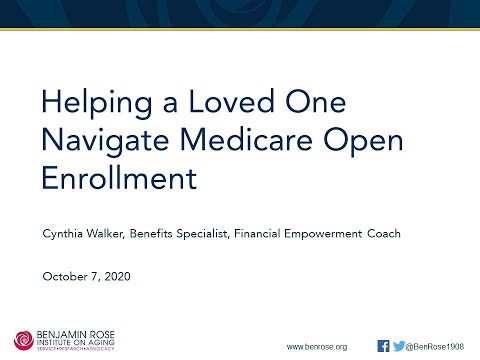
Helping a Loved One Navigate Medicare Open Enrollment October 7 virtual program for caregivers from Benjamin Rose Institute on Aging. Read more
Understanding and Coping with Ambiguous Grief as a Caregiver Loss is not an unfamiliar concept, as we all experience it in some form through relationships with people and changes in our health. Grief is described as a process that we go through to cope with, move through and move on from a significant loss. However, there is a type of loss and grief that caregivers experience that has its own unique properties. Read more
Building and Supporting Dementia-Inclusive Communities According to the World Health Organization, an estimated 50 million people are living with dementia worldwide. To combat the impact that dementia has on people living with the disease and their caregivers, the Dementia Friendly America initiative was launched to create communities where everyone could provide support and understanding to these individuals. The initiative aids the residents who are living with dementia and their caregivers in the community by raising public knowledge about the disease, supporting people living with dementia and their caregivers and connecting health systems with community-based organizations. Read more
What Does Dementia Look Like? "My dad had lots of good days, days filled with laughter and conversations about his favorite memories of my childhood and his, days where he remembered many of the “little things” in my life that made me feel like he wasn’t aging at all. There were other days, though, when Dad was not as sharp. In fact, there were days when Dad really wasn’t Dad." Read more
A dyadic perspective on assessment in Alzheimer’s dementia: Supporting both care partners across the disease continuum. Written from a dyadic strength‐based perspective, this article first provides a brief overview of the Education, Information, and Support section of the 2018 Alzheimer's Disease Dementia Care Practice Recommendations.1 Subsequent sections present a comprehensive overview of available valid and reliable psychosocial measures that assess a selection of important domains for dementia care planning that can be used by families from early stage until end‐of‐life. Measures selected for the purposes of this article will focus on concepts that are strength‐based and most relevant to care dyads as they navigate the difficult disease trajectory: readiness, knowledge, coping, dyadic relationship, care values and preferences. We will also highlight measures that have traditionally targeted the family care partner but can potentially be considered for use with the care partner with dementia, with adjustments, beyond the early stages. Part of this discussion will include various strategies for including persons with dementia in all aspects of their own care using a strength‐based perspective, potentially enabling them to answer questions more reliably across disease stages. Last, gaps in existing measures will be identified to provide options to better assess areas of need most meaningful to families, and in ways that positively contribute to the successful aging of those living with dementia and their care partners. Read more
Helping an Older Loved One with Housekeeping As caregivers, we may need to step up and lend a hand with keeping the household tidy, especially if clutter becomes a tripping hazard or important areas of the house such as the kitchen or bathroom are becoming unsanitary. However, we should also be sure to empower a loved one to continue doing the household tasks they are still capable of doing by trying different strategies that allow them to stay both safe and independent. Read more
Bathroom Safety for a Loved One with Late Stage Dementia These days, about 80 percent of people with Alzheimer’s disease and related dementias (ADRD) stay in their own homes with the support of family and friend caregivers rather than move to long-term care facilities. While aging in place can provide a loved one with a familiar, comforting space, it can also lead to challenges related to the safety of the home environment. Things around the house like stairwells, area rugs, medicine cabinets and knife blocks that were once a normal part of a loved one’s living space may now present new dangers with ADRD. Read more
Transitioning Away from Working—and Caregiving—at Home During COVID-19 While the pandemic has been challenging for many people, those who are already stretched thin have been pulled even more so. Just when we think we have mastered the juggling and multi-tasking, school in some form has begun again, employers are talking about transitioning back to on-site work environments, and we may not be able to help the older loved one we care for navigate their own time staying at home during the pandemic in the same way. Read more
How to Find Respite as a Caregiver During COVID-19 Carving out time in our day dedicated to ourselves with no outside distractions is challenging enough during the best of times. But during the COVID-19 pandemic, many of these distractions are coming from inside—and with ‘inside’ being the safest location to be, it may feel next to impossible to get away from them. Those who are sandwich generation caregivers may be juggling work tasks with 24/7 parenting and managing the care of an older loved one, leaving no moments of the day set aside for personal time and self-care. For others, loved ones may need more frequent support if their adult day programming or senior center activities are still canceled or reduced. Or, many of us may simply be struggling to find avenues of self-care and respite when the relaxing activities we previously enjoyed—going to the spa, scheduling a vacation—may not be as simple as they once were. Read more
Neighborhood Engagement, Dogs, and Life Satisfaction in Older Adulthood Objectives This study examined the relationships between dog ownership, dog walking, and the emotional bond with a dog to neighborhood engagement and life satisfaction among those over age 50. Method Using data from the Health and Retirement Study (N = 476), two path analysis models were conducted to test the research hypotheses. Results Findings indicated that dog ownership did not have a direct or indirect relationship on life satisfaction. However, time spent in dog walking was associated with frequency of social interactions, which itself had a positive association with life satisfaction. The bond with a dog was not directly associated with life satisfaction but was associated with dog walking. Discussion Dog walking is a promising strategy for simultaneously promoting better health and social engagement, and these factors in turn can promote greater life satisfaction of older adults. Read more